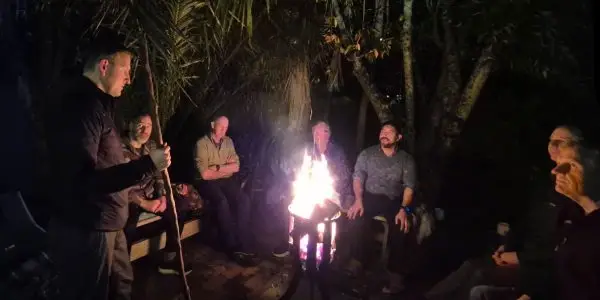


When the sharing in a men's group goes deeper — past the surface story or the immediate crises — certain themes come up again and again. Two in particular surface with striking consistency, regardless of a man's age, background, or why he first walked through the door: his relationship with his father, and his relationship with his mother. Not the surface relationship, but the one underneath. The one that shaped him before he had words for it.
The father relationship
Like it or not, the relationship with our father, or his absence, sits at the core of most men's inner lives. He lives in us genetically and emotionally. The critical father tends to produce men who are deeply self-critical, prone to depression, and chronically underachieving. The absent father produces young men searching for belonging, initiation, and a model of what it means to be a man, and we see the consequences of this clearly in gang culture. The violent father produces men for whom aggression becomes the only available response to threat. Love him or hate him, father holds our self-esteem.
Guy Corneau mapped this territory carefully in Absent Fathers, Lost Sons, a psychoanalytic exploration of how a father's emotional absence shapes men and what is needed to reclaim the initiation that was never received. James Hollis covers similar ground with great depth in Under Saturn's Shadow. What both confirm is something men's groups encounter regularly: disliking or hating our father often translates, quietly and unconsciously, into disliking or hating ourselves. Depression, addiction, suicide — these are not random afflictions but are very often the downstream effects of an unexamined relationship with the first man in our lives.
One of the places this plays out most visibly is in how men parent their own children. A man whose father was absent, critical, or emotionally shut down often arrives at parenthood without a working template for what a connected father looks like — and may find himself either repeating what he experienced, or overcorrecting in ways that bring their own complications. Many men only begin to examine their relationship with their father when they become fathers themselves, because that is when the weight of the inheritance becomes impossible to ignore.
What helps is understanding him. Learning about his childhood, his own wounds, his limits — from family, from stories, sometimes just from honest reflection — can unlock something significant. Not excusing what happened, and not pretending it was fine, but understanding it in a way that makes forgiveness possible. And forgiveness, as many men discover in a group, turns out to be less a gift to the father and more a release for themselves.
The mother relationship
For boys, the primary female carer, most often mother or grandmother or both, is the first template for what a woman is, what relationship with a woman feels like, and what to expect from intimacy. This is where we learn, before we have language for it, whether love is safe, what we have to do to earn it, and what happens when it disappears.
When that template is distorted — by a father who has left, a stepfather who brings harm, or a mother who through no fault of her own must carry both parenting roles alone — boys absorb those patterns and carry them into adult life. The ten-year-old declared the man of the house is carrying a weight he was never built for, and it tends to show up decades later in how he relates to women, to intimacy, and to himself.
This shows up most clearly in romantic relationships. A man whose mother was warm and nurturing may unconsciously seek that same quality in a partner, sometimes to the point of recreating a dynamic that is more parent-child than equal. A man whose mother was emotionally unavailable, critical, or absent may spend years chasing connection that never feels like enough, or may find himself drawn to partners who recreate the familiar ache of not being loved in the way he needed. These are not character flaws. They are learned patterns, formed early and reinforced over time, and most men carry them without ever having named them. A men's group, over time, tends to be one of the few places where a man can begin to see these patterns clearly — not through professional analysis, but through the honest reflection of other men who recognise what he's describing because they've lived versions of it themselves.
Terry Real's I Don't Want to Talk About It is one of the most important books in this space, offering a close and honest look at male depression, how it differs from depression in women, and how unresolved relational wounds drive so much of what men struggle with quietly for years.
You can find these and other relevant titles on our further reading and resources page.
What a men's group can do
Neither wound is a life sentence, but both tend to stay underground until something brings them to the surface, and that something is usually a crisis. A men's group offers a place where these things can be named, heard, and worked with at whatever pace feels right. Many men find that simply hearing another man describe his own experience of these wounds, and recognising themselves in it, is the beginning of something important.
This is not therapy, but for many men it turns out to be some of the most valuable work they will ever do. Many of the patterns described here are also expressions of what Jung called the shadow — explored further in our article on shadow work, and in our piece on the deeper work of men's groups.