

Most men have never been taught how to grieve. They've been taught to absorb difficulty, to keep moving, to hold things together. And so when loss comes — and it always comes — many men do exactly what they've always done. They carry on. They manage. They're fine.
Except they're not fine. They're carrying something heavy, largely alone, often without the language to describe it or the space to put it down.
What grief looks like for men
Grief is most commonly associated with bereavement — the death of a parent, a partner, a friend. But men carry many other forms of loss that are rarely named as grief: the end of a relationship, distance from children after a separation, a career that collapses, the slow realisation that a friendship has quietly ended. These are all forms of grief, and they accumulate.
Men who haven't processed earlier losses often find that a new one hits harder than expected. A father dies and the grief is not just for the father but for every unresolved thing between them. As we explore in our piece on the father wound and the mother wound, grief for a parent is often grief for much more than the person. Grief has layers, and those layers tend to surface together.
Why men struggle to grieve
The cultural expectation to be strong translates, in practice, to not being visibly affected and getting back to normal quickly. Men who grieve openly can feel like they're failing at something.
There's also the absence of a place to take it. Many men don't have close friendships where difficult feelings can be shared — a pattern explored in our piece on the male loneliness epidemic. Their closest relationship is their partner, and when she or he is also grieving, or is the source of the loss, there is nowhere left to go.
So grief goes underground. It surfaces as irritability, withdrawal, a low-grade numbness that persists long after the acute loss has passed. Sometimes it eventually breaks through in a moment that feels disproportionate — or in a men's group, holding a talking stick, saying something out loud for the first time.
Grief that hasn't moved
One of the most consistent observations in men's group work is that unprocessed grief is almost universal. Most men are carrying something they haven't fully felt — old losses set aside because there was no time or space to sit with them.
This is closely related to what shadow work addresses. Grief pushed down long enough becomes part of the shadow — showing up sideways, in forms the man doesn't recognise as grief at all.
What often surfaces in a group is not the grief itself, initially, but the numbness around it. A man speaks about something — a father who died, a marriage that ended — with a detachment that suggests the feeling has been put somewhere out of reach. Over time, in a space where honesty is normal and other men are not afraid of tears or silence, that detachment begins to loosen.
What it means to be heard in grief
There is something specific that grieving men need and rarely receive: to be heard without the conversation being redirected. Most well-meaning people feel an urge to offer perspective, find the silver lining, suggest what might help. This instinct, though kind, can leave a man feeling more alone than before.
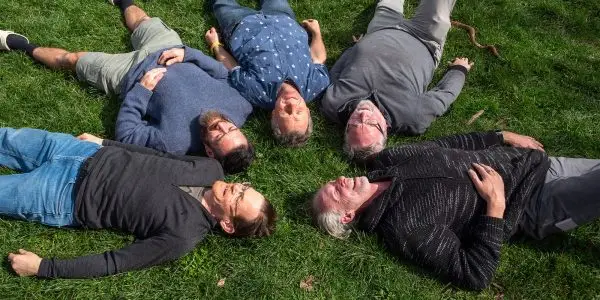
In a men's group, a man who is carrying grief is heard without interruption, without being fixed. Other men in the group may have carried similar things. That recognition — not advice, but recognition — is often what begins to shift something.
If something in this piece resonates, a men's group may be worth exploring. You don't need to know what you want to say before you walk through the door. You just need to show up.