

There's something that happens to a man when he gets out of the city and into the bush. The noise drops away. Not just the noise of traffic, but the noise in his head: the mental list-keeping, the low-grade hum of obligation, the accumulated weight of everything he's supposed to be doing.
He starts to breathe differently. He looks up. He notices things.
For many men, this is the closest they come, without any particular practice or intention, to being fully present in themselves. Just by going outside. Touching grass, as the kids say.
Those facilitating men's work have always known this. The most powerful gatherings tend to happen in close proximity to wild spaces, away from ordinary time. There's a reason cultures around the world, across millennia, sent young men into the wilderness as part of initiation: not to toughen them up, but because something essential can only be reached through a combination of wild nature, the company of elders, and a deliberate breaking open of the boy-self to allow something more mature to emerge.
What nature strips away
Jamie Howell of the Centre for the Great Turning asks a question that cuts to the heart of this: if human beings were more like a plant, what would the soil be? What nutrients do we need to feel we belong, and to align with the gifts we're carrying? For many men, nature turns out to be part of that answer.
Modern life is extraordinarily good at keeping men occupied on the surface. Work, obligations, screens, logistics, money to track. None of this is bad. But it means the deeper layers of a man's psyche can go largely unvisited for most of his life.
Nature doesn't particularly care about any of that. A tree doesn't know what you do for work. A river doesn't care whether you're behind on your emails. The bush is indifferent to your identity in a way that can feel, at first, almost disorienting, and then, slowly, like relief.
When the outer noise drops, something else becomes audible: feelings that have been waiting, questions that haven't had space to form, a shifting sense of what actually matters. This is what men's work is often trying to create. Nature often does it without any of the effort.
The body comes back online
Men are often more comfortable in their heads than in their bodies. We're trained to think our way through things, to manage and analyse and produce. The body gets treated as the thing that carries the head around.
Outside, this shifts. You're cold, or hot. Your feet are wet. There's a view that makes your chest feel wide. Your legs are tired in a good way. The body stops being background and becomes present and real.
David Abram, in Becoming Animal, argues that human perception is not something that happens inside the skull but between us and the living world. We are sensory beings shaped by exchange with the earth, the wind, the texture of bark and stone. Cut off from that exchange, something in us goes dull. Re-entering it, something wakes up.
Many men who spend real time in nature notice this: a sparkle returns to the eyes, a loosening in the body and mind, an energy that had been dormant. It's not just relaxation. It's closer to what Bill Plotkin calls soul desire: a deep, instinctive aliveness that reconnects a man to what he's actually here to do. The same quality, notably, is what men often report after a meaningful men's retreat. The two aren't unrelated.
The more-than-human world
There's a phrase used by thinkers working at the edge of psychology and ecology: the more-than-human world. The natural world is not a backdrop to human life, or a resource, or a place for recreation. It is a community of beings, with their own intelligence and presence, that we are part of, not separate from.
In Māori understanding, te taiao has never been separate from human life. The land, rivers, and sea are not resources but relations, whakapapa expressed in living form. This is a fundamentally different relationship to nature than the one most of us were raised with, and it points toward something worth recovering.
Bill Plotkin suggests that our severance from the living world is one of the unacknowledged sources of modern psychological distress: that we are lonely not just for human connection, but for contact with the world we belong to. True wildness, in this framing, is not about recklessness. It's a deep love for nature, a delight in silence, a fearless curiosity about the unknown, and a voice that speaks spontaneously and authentically rather than performing what's expected.
Rewilding
Rewilding, in the ecological sense, means restoring what has been lost: reintroducing species, allowing wildness to return, letting a landscape become itself again. Applied to men, the idea is similar. Something has been domesticated out of us, not our worst impulses, but our aliveness, our instincts, our capacity for wonder, solitude, and genuine risk.
Rewilding for men doesn't mean abandoning responsibility. It means deliberately spending time in wild places, learning to be with discomfort, and recovering the felt sense of belonging to the earth rather than simply passing through it. In Aotearoa, events are being run specifically with this in mind. Our events page lists what's coming up.
Nature and the soul's work
In traditions of depth psychology, and in the men's work they have influenced, the soul is the deepest, most authentic layer of who a man is: not his personality or his social role, but something older, with its own direction and its own grief when that direction goes unheard.
Bill Plotkin draws a direct line between nature and the soul. Wild places call out what is most essential in a person, and the journey into wild nature is, in this sense, the same as the journey inward. A man who has gone somewhere quiet and real in the landscape is better prepared to go somewhere quiet and real in himself.
This is the territory that vision quests and wilderness fasts have always worked in. Alone in the landscape, stripped of the usual supports, the role he plays, the people who depend on him, the masks he wears, the stories he tells himself about who he is, all of this begins to dissolve. Something hidden gets a chance to surface. Men who have done this kind of time alone often describe touching something they can only call their true calling: a sense of who they really are beneath decades of conditioning, a voice they finally recognise as their own.
You don't need a vision quest to touch this. A night alone under the stars, a long solo walk, a morning by a river before anyone else is up: these can be enough to create a crack in ordinary life where something quieter and truer can be heard.
Myth, wildness, and the green man
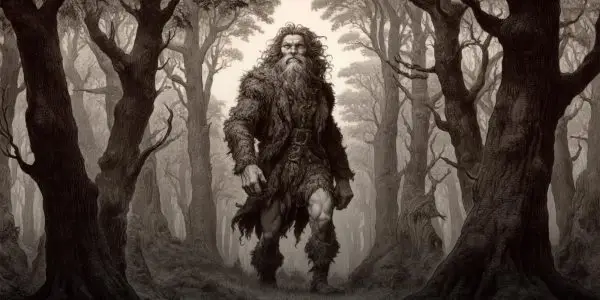
Across many cultures there are figures who carry the archetype of the wild man: the one who lives at the edge of the tamed world, who belongs to the forest as much as to the village, who knows something the comfortable and domesticated have forgotten.
In European folklore the Green Man appears again and again: a face peering out from leaves, vegetation growing from his mouth, carved into the stonework of churches across centuries. He represents something that refuses to be civilised away: the vitality, the earthiness, the aliveness that runs beneath the surface of respectable life.
Storyteller and mythologist Martin Shaw writes about the importance of this wildness in the male psyche, not as licence for recklessness, but as contact with what is raw and alive in us. The old stories he works with are full of men who must leave the known world, enter the dark forest, encounter the threshold, and return transformed. The forest is not decoration. It is the place where the ego's usual strategies fail and something deeper must be called on. This is also the structure of initiation, and of much of what happens in men's work. Nature is not incidental to that process. In many traditions, it is the necessary container.
Simple ways in
None of this requires a wilderness retreat or a spiritual framework. The simplest version is just: go outside and pay attention.
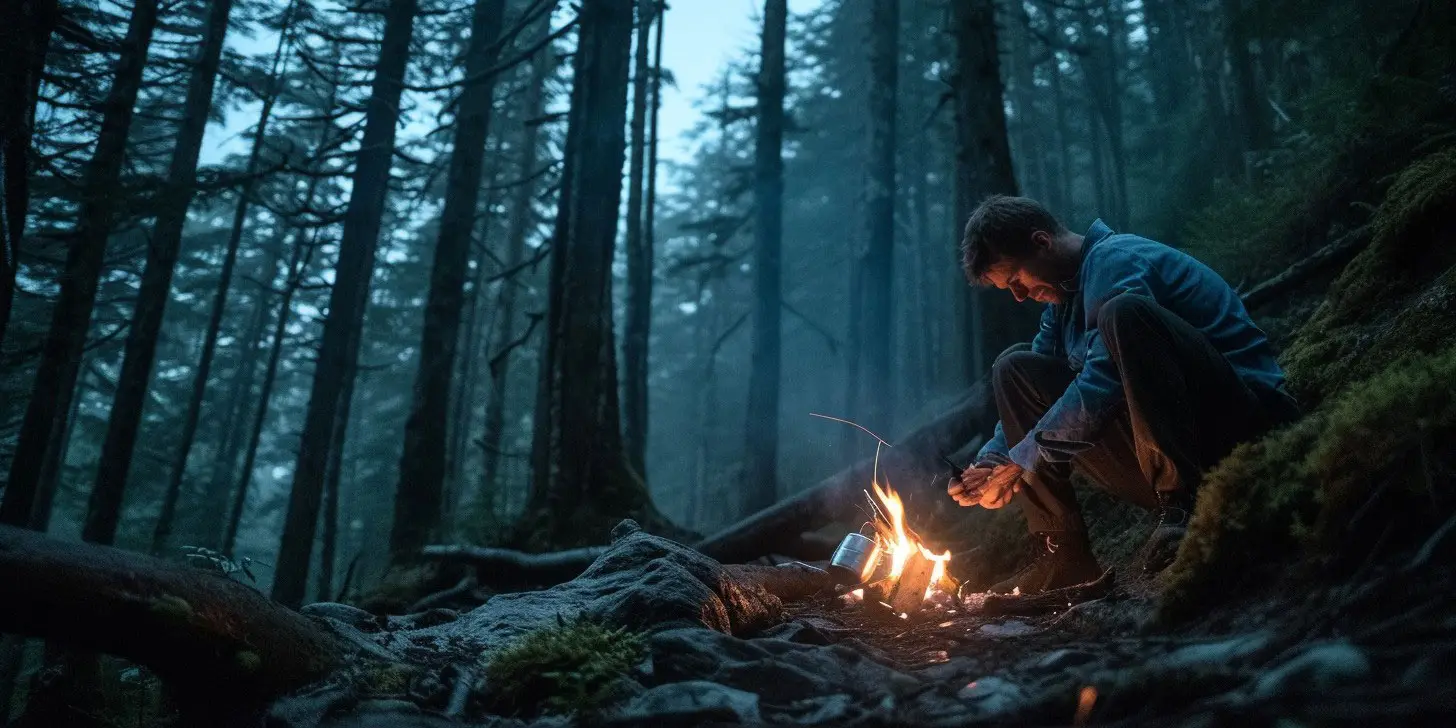
Walk without a destination. Sit by water. Light a fire and stay with it for an hour. Sleep under stars. Take your men's group meeting outside instead of into a room. Try a solo sit: an hour alone in a natural place, no phone, no book, just being there.
Notice what relaxes. Notice what surfaces when the usual distractions are gone. Notice what stories you tell about yourself that simply drop away when something more immediate takes hold. What felt important that, in this quieter place, clearly isn't? What do you actually want? Who do you actually want to be?
But nature alone is only part of it. The other essential ingredient is what Jamie Howell calls the return: the moment when a man comes back from the threshold and is witnessed by his community. Without that, transformation struggles to take root. The men's group, the circle, the gathering of men willing to see and be seen, is where what nature opens gets integrated and given roots.
Go deeper
- Read more about the traditions behind this work: how men's work is helping reclaim the rite of passage modern life took away
- Explore the role of myth and story in men's work: why we use stories and myth in men's work
- Find a men's group near you: browse groups across Aotearoa
- Find a men's retreat: upcoming events and gatherings