


Many men share a sense that somewhere along the way, something important was supposed to happen, but didn't. A transition was never completed, a threshold never crossed. It's not a feeling of failure exactly, but an absence. It's the feeling of being a grown man on the outside, while something unfinished remains on the inside.
This feeling is more common than most men realise, and it has a name: the missing rite of passage.
What is a rite of passage?
For most of human history, the transition from boy to man was not left to chance. It was marked deliberately, communally, and often profoundly. These weren't just ceremonies — they were experiences designed to break something open: to separate a boy from his childhood identity, put him through an ordeal that tested his character, and return him to his community as a man, seen and acknowledged by the men who came before him.
The details varied across cultures, but the underlying structure was consistent: separation, ordeal, return. And at the heart of it was older men who knew what was needed, and were willing to show up for the next generation.
What we lost, and how we lost it
Modern Western society dismantled most of this, gradually and without much notice. Industrialisation broke up extended family structures. Indigenous wisdom was lost in colonisation and forced re-education. Two world wars sent a generation of potential mentors into the ground. Suburbanisation isolated families. The rise of capitalism and the emphasis on individualism replaced communal identity with personal achievement. More recently, social media has furthered our slide toward isolation, obscured under the mask of promised connection. Throughout all of this, the thread connecting older men to younger men, and with it the transmission of hard-won wisdom from one generation to the next, has been quietly fraying.
What replaced the rite of passage? For most men, a loose collection of milestones with no real container around them: getting a driver's licence, finishing school, leaving home, first job, first drink. These things mark time but they don't signify real transformation. Nobody witnesses them in any meaningful way. Nobody says: we see you, you are one of us now, go forward as a man.
The result is what the psychologist Robert Bly called "soft males" — men who are educated, well-meaning, and functional, but who have never been genuinely initiated into their own depth. In his landmark work Iron John, Bly used the Grimm fairy tale of the Wild Man as a metaphor for what modern men have lost access to: not aggression or dominance, but a deep, grounded masculine energy that can only be reached through initiation. The Wildman is not the savage. He is the initiated man's connection to something ancient and alive in himself.
A related but distinct archetype is the Green Man, an ancient figure found carved into medieval cathedrals and woven through pre-Christian traditions across cultures. Where the Wild Man represents instinctual inner depth, the Green Man embodies a masculine energy rooted in nature, stewardship, and interconnection. He models strength through relationship rather than dominance, and stands as a counterpart to the Earth Mother in the Jungian tradition.
Underlying all of these archetypal figures is Carl Jung's concept of archetypes: universal patterns of the psyche that live in the collective unconscious and shape how we develop as human beings. Joseph Campbell mapped one of the most important: the hero's journey, with its arc of separation, ordeal, and return — the same structure found in virtually every initiation rite across human cultures.
Building on Jung, Robert Moore and Douglas Gillette identified four core masculine archetypes — the King, Warrior, Magician, and Lover — and argued that uninitiated men don't access their mature forms. Instead they live in their shadows: the tyrant, the sadist, the trickster, the addict. The rite of passage is what moves a man from boy psychology into the mature expression of each archetype: grounded power, directed strength, deep knowledge, and embodied passion.
For a closer look at the shadow and how men's groups help bring it to light, read our article on shadow work.
The fire and the circle
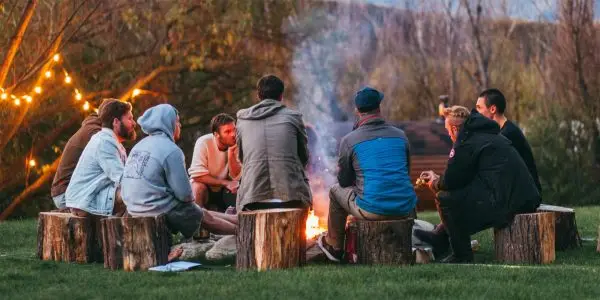
Also lost along the way to modernity was something simpler and older than any formal ceremony: the gathering of men around a fire. Sitting around a fire naturally enforces a circular arrangement, with every man equal, every face visible, and a shared focal point at the centre. For most of human history, this was where important transmission — and transformation — happened. Where older men told stories, shared hard-won wisdom and survival skills, and younger men listened and learned what it meant to navigate life as a man. The fire was not incidental. Something about the circle, the darkness, the warmth, and the hypnotic quality of flames creates an openness that is difficult to replicate indoors. It connects us to nature, wisens the tongue, and lends profundity to the storytelling. And in the gaps between words, silence was there, doing its own profound work — not the uncomfortable silence of men who don't know what to say, but the deep, settling silence of men who are truly present with each other.
It is no coincidence that some of the most powerful men's group gatherings still happen outside, in circle around a fire — a deliberate reaching back toward something ancient and proven, something the body recognises even when the mind has forgotten it.
The role of elders, and their absence
Alongside the loss of initiation is the loss of elder mentorship. In traditional cultures, older men didn't just witness initiation, they guided it. They carried knowledge that could only come from having lived, suffered, made mistakes, and found their way through.
Modern society has largely separated generations from each other. Older men are retired to the edges of community life. The workplace provides transactional relationships but rarely wisdom. Fathers, where present, are often doing their best with incomplete maps of their own, not to mention their own struggles and trauma to navigate. The result is that many young men grow up without a single older man who genuinely knows them, challenges them, and helps them find their footing as adults.
Without elders or mentors, men have no mirror for what maturity actually looks like. No one to tell them: what you're going through is normal, here's what it means, these are the challenges worth going through, and here's what's on the other side.
Disconnection from feeling and from the natural world
Two other threads run through this story. The first is emotional disconnection. Traditional rites of passage didn't just mark a social transition. They also opened deeper emotions and gave them a place to land: fear, grief, vulnerability, and wonder. These were not weaknesses to be overcome but essential parts of becoming fully human. Modern boys are rarely given permission to feel any of them fully, let alone in the presence of other boys or men.
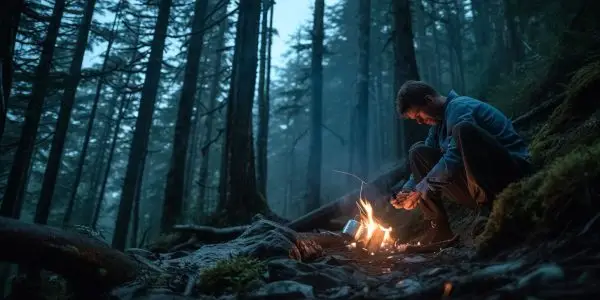
The second is disconnection from nature. Bill Plotkin, psychologist and wilderness guide, argues that modern Western culture has produced a society stuck in "adolescent psychology" — endlessly striving, consuming, and performing, but never making the descent into the deeper self that genuine maturity requires. That descent almost always requires nature: solitude, darkness, physical challenge, and an encounter with something larger than the ego.
The loss of that encounter leaves a gap that ambition, achievement, and even loving relationships cannot fill.
What men are doing about it
Men are slowly finding their way back to this territory. Not through any single movement or ideology, but through a growing recognition that what was lost can be rebuilt.
Initiation weekends like ManKind Project's New Warrior Training Adventure and Essentially Men's Men Being Real provide structured, intentional multi-day experiences designed to do something similar to what traditional cultures once did. Some groups, particularly those in the ManKind Project tradition, use Moore and Gillette's four archetypes as a living framework — helping men recognise which aspects of mature masculinity they are embodying and which remain underdeveloped or in shadow. Other groups engage with these ideas more loosely, without the formal structure, but with similar effect: men naturally moving toward greater wholeness as trust deepens and honest self-examination becomes the norm.
Organisations like the Rites of Passage Foundation in Golden Bay work with young men specifically, restoring the missing transition from adolescence to adulthood through land-based experiences and elder mentorship.
The work of Bill Plotkin and the Animas Valley Institute takes this further, offering nature-based soul initiation programmes rooted in depth psychology and wilderness immersion. His writing has influenced a generation of men's work facilitators worldwide, and offers one of the most complete frameworks for understanding what genuine initiation actually requires.
And men's groups — like those listed at mensgroup.nz, meeting regularly in circles across New Zealand — provide something that fills this gap in a different way. Not a one-time event, but a regular practice of honesty, accountability, and mutual support that deepens over years. For many men, a men's group is where the work of initiation continues long after any single weekend or wilderness experience. It's a place to be known, challenged, and held accountable to the man they are becoming.
None of these are perfect substitutes for what was lost, but they are genuine attempts to answer the same question that every rite of passage has always tried to answer: who are you, what is your purpose on this planet, and are you ready to show up as the man you know you can be?
The missing passage doesn't have to be permanent
If any of this resonates, you're not alone, and you're not broken. So many men feel that internal sense of something unfinished — of being stuck on the surface with no real, grounded purpose. It's a valid response to a real absence, one that many men before you have felt, and that many men are actively working to address.
The threshold to true adulthood is still there. It's just waiting for you to find it.
Further reading
For a more contemporary look at how these forces are playing out for men today, read our post on what it means to be a man in 2026.
If you're wondering what makes a men's group different from therapy, social clubs, or other male spaces, we've covered that too: how a men's group differs from other male spaces.