


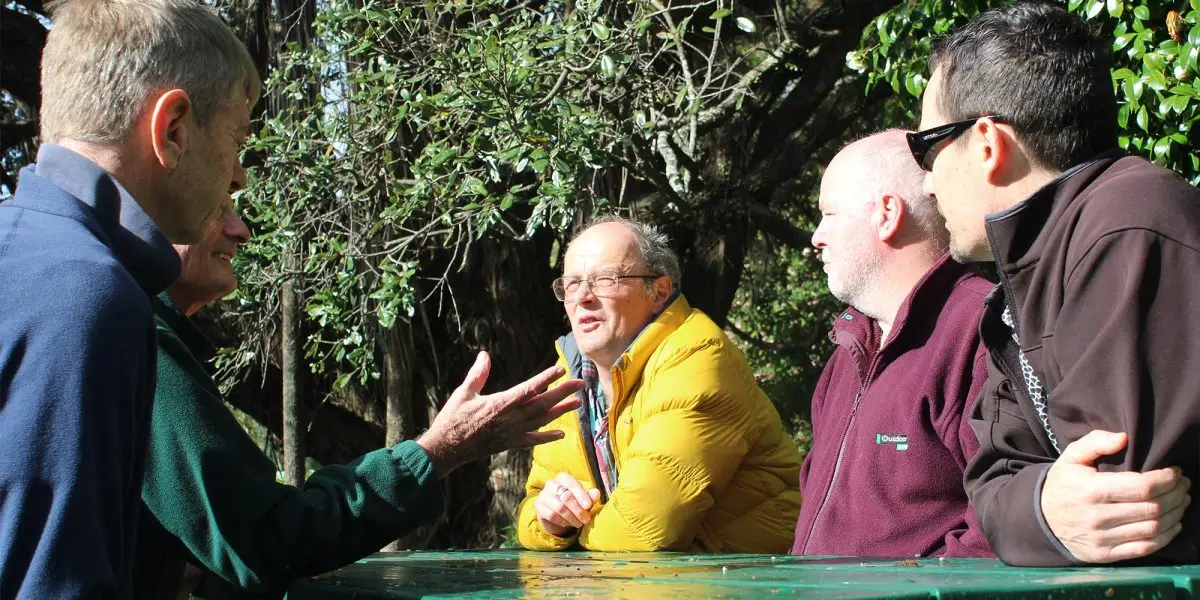
Men's groups are spaces where men can say the thing they've never said aloud, sit with something hard, or simply be witnessed without judgement. That kind of depth doesn't happen by accident. It depends on the group holding a container safe enough for a man to lower his defences.
Banter is part of male culture. For many men it's one of the primary ways they express affection and belonging. Taking the piss out of your mates is a love language of sorts, and there's real value in it. A well-aimed joke can shatter false pride, keep a man grounded, signal that the bond is strong enough to handle a bit of edge. None of that is worth losing.
But banter in the circle can work directly against the intention of the space.
The deflection joke
Most men spend their daily lives in environments where vulnerability isn't safe. Work, sport, and social spaces reward composure, competence, and humour. Men get good at managing how they're seen.
The circle exists to offer something different. A space where a man's nervous system can settle, his defences can stand down, where he can access parts of himself not normally available. That opportunity is rare and worth protecting.
When a man is mid-share and someone lands a put-down or calls out an offensive name, or there's laughter at his expense, the signal is clear: this isn't that kind of safe space. He pulls back. Maybe not consciously. But the moment is gone.
There's a specific version worth naming. A man starts sharing something real, something with weight. The emotional charge in the room rises. For men not used to sitting with that intensity, the discomfort can be hard to hold. Someone cracks a joke, the room laughs, the tension breaks. It feels like relief. But the man who was opening up just learned that this group can't quite hold what he was about to bring. He won't go there again in a hurry.
The in-group problem
In longer-running groups, banter is often deeply embedded in the culture. Men who've been coming for ten or twenty years have built real friendships. The humour is genuine affection. It's how they say: I see you, and I'm not going anywhere.
But for the man attending for the first or second time, trying to get a read on whether this is a place he can trust, banter lands differently. It tells him that this circle isn't entirely serious. That there's an in-group he's not part of yet. That depth has limits here.
This may be one reason some men come once and don't return. Not because they were challenged too hard, but because the space didn't feel consistently held. They never say why. They just don't come back.
There's also the subtler pattern of banter used to deliver feedback indirectly. If someone is consistently late, or dominates the room, jokes start appearing about it. It feels lighter than a direct conversation. But indirect sniping creates no clarity and leaves the man no room to respond. Saying it straight is harder and cleaner: "When you take repeated tea breaks during circle sharing it disrupts the group, and I want to know if you're committed to this."
Discernment, not self-suppression
This isn't an argument for a humourless circle, or for men performing a sanitised version of themselves.
A man who can move fluidly between sharp wit and genuine presence isn't suppressing himself. He's showing range. He knows when levity lifts the room and when it closes it down. He can laugh hard with his brothers, and he can sit in the heaviness with them too, in silence, with respect.
He also knows that the kitchen, the walk, the time after circle, are different spaces entirely. Banter is welcome there. But the circle demands more from him. The capacity to read the moment and respond to what it's actually asking for is part of what men's work is trying to develop.
The circle is one of the places we practise it.
For the guiding principles that underpin how groups navigate these moments, see the men's group guiding principles